
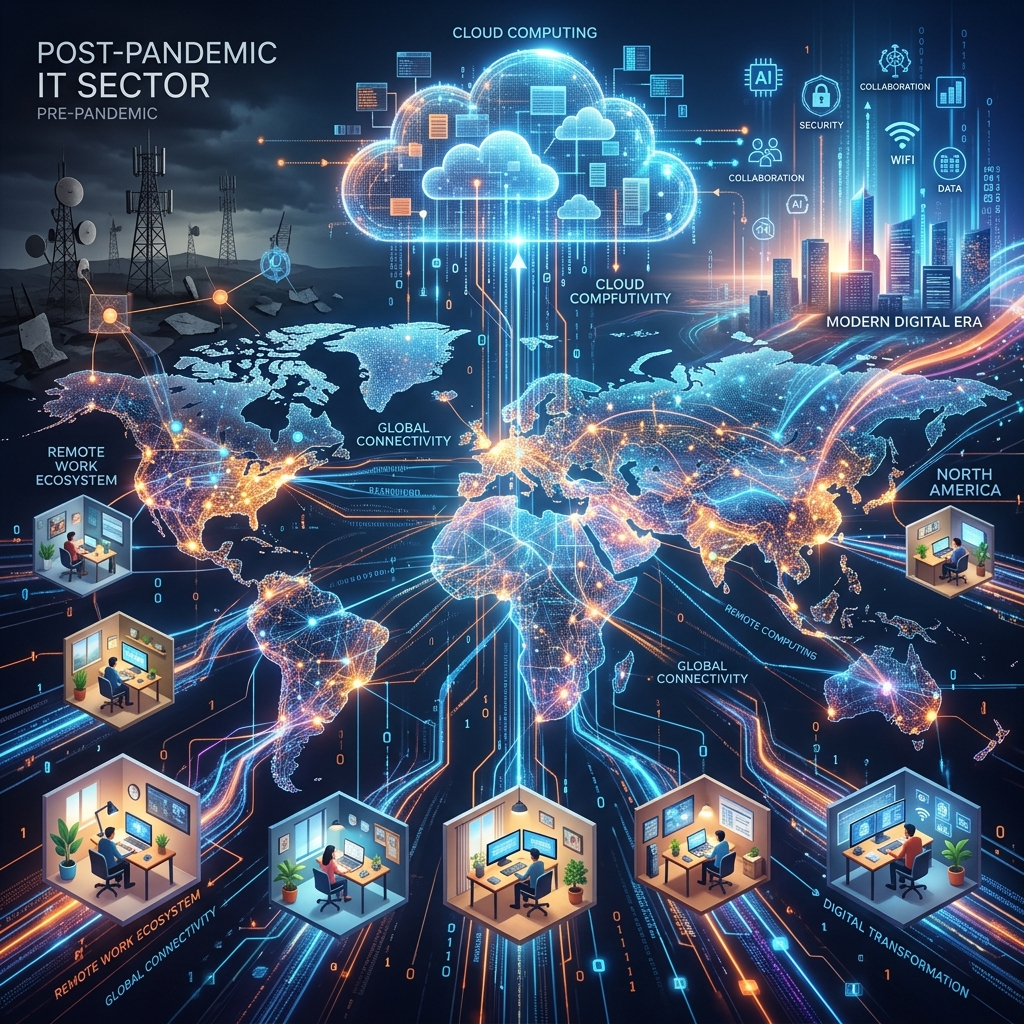
The COVID-19 pandemic fundamentally transformed the IT industry, accelerating digital adoption by years and reshaping how businesses operate, communicate, and deliver value. Here is how the pandemic impacted the IT sector and the new era it awakened.
How the Pandemic Changed IT
Remote Work Revolution
The overnight shift to remote work forced organizations to adopt collaboration tools, VPNs, cloud infrastructure, and virtual meeting platforms at unprecedented speed. What was once a perk became the norm, and many companies have since adopted permanent hybrid or fully remote models.
Cloud Computing Acceleration
Organizations that had delayed cloud migration were forced to act. Cloud adoption surged as businesses needed scalable, accessible infrastructure to support distributed teams. AWS, Azure, and GCP saw massive growth during and after the pandemic.
Cybersecurity Priority
The expanded attack surface from remote work — personal devices, home networks, VPN vulnerabilities — elevated cybersecurity from an IT concern to a board-level priority. Zero-trust architectures, endpoint protection, and security awareness training became essential investments.
Digital Transformation Fast-Track
Industries that had been slow to digitize — healthcare, education, government, retail — were compelled to build digital channels rapidly. Telemedicine, e-learning platforms, contactless payments, and e-commerce saw explosive growth.
E-Commerce and Digital Services Boom
Consumer behavior shifted dramatically toward online purchasing. Businesses invested heavily in e-commerce platforms, digital payment systems, logistics technology, and customer experience optimization.
AI and Automation Adoption
The need to do more with fewer people accelerated AI and automation initiatives. Chatbots, robotic process automation (RPA), predictive analytics, and intelligent document processing saw rapid enterprise adoption.
The New IT Era
- Hybrid work infrastructure is now a baseline requirement, not an exception.
- Cloud-native architectures are the default for new applications and services.
- Cybersecurity is embedded into every layer of technology strategy.
- Digital-first experiences are expected by customers, employees, and partners.
- AI and automation are core capabilities, not experimental projects.
Lessons for businesses
- Build resilient, cloud-based infrastructure that scales with demand.
- Invest in cybersecurity as a continuous program, not a one-time project.
- Prioritize employee experience alongside customer experience in digital transformation.
- Adopt agile development practices to respond quickly to market changes.
Need help modernizing your IT infrastructure for the post-pandemic world? ITAIMS can guide your transformation.